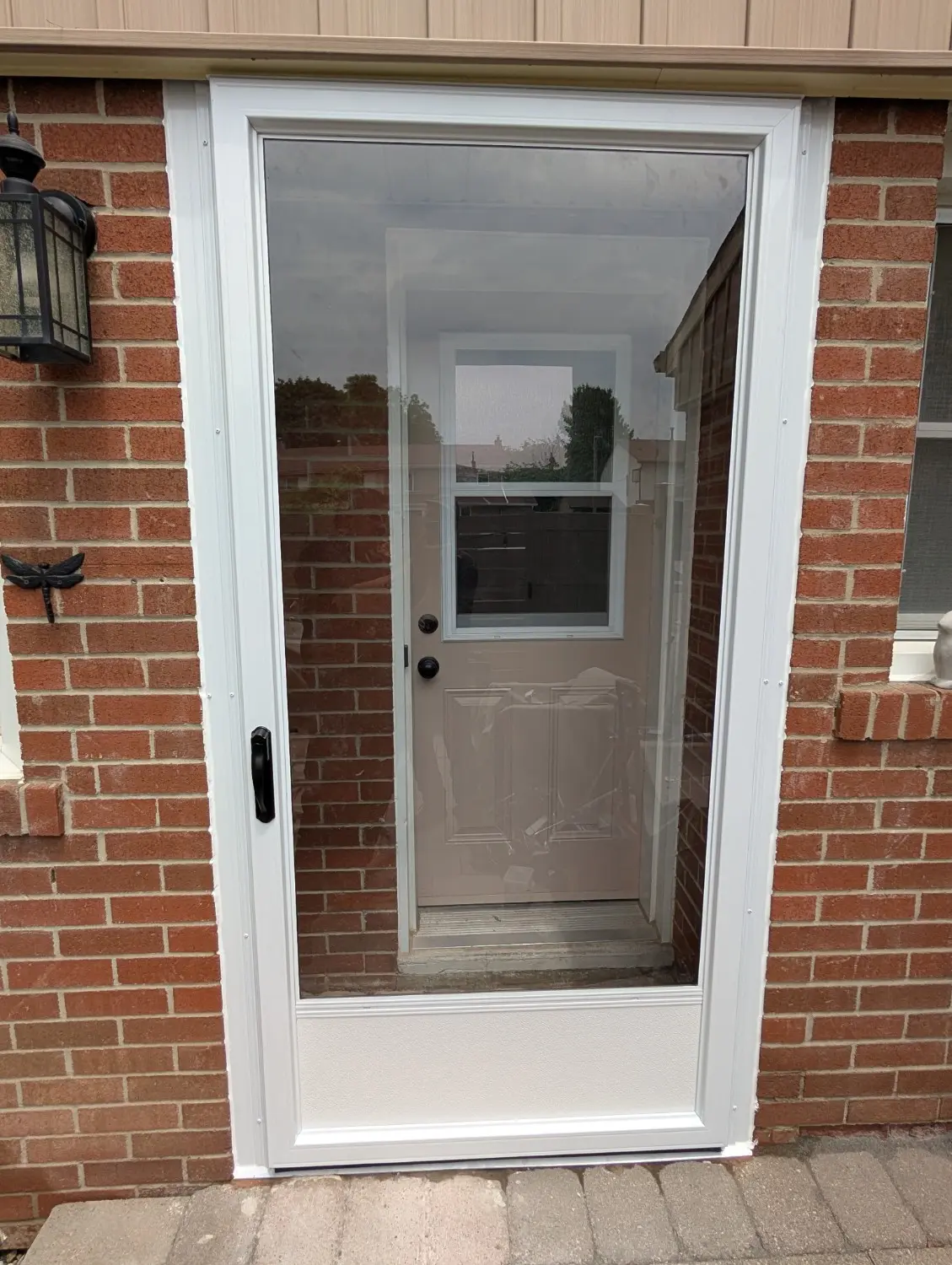
A storm door only earns its keep when it seals — and it only seals when it fits. Measuring for a storm door is simpler than measuring for a sliding screen, but the traps are sneakier: openings that aren’t square, trim that steals mounting depth, and the handing question everyone answers backwards. Here’s how to measure a storm door opening properly, the way our installers do it across Toronto and the GTA.
Where You Actually Measure
A storm door mounts to the door frame’s exterior trim (the brickmould or casing), not to the entry door itself. Everything you measure happens inside that trim opening — the rectangle of space the storm door frame will fill.
Step 1 — Width, Three Times
Measure the opening width between the inside faces of the trim at the top, middle and bottom. Record all three. If they match within about 6 mm, your opening is friendly; use the smallest. A bigger spread means the opening is out of square — normal in older Toronto homes, and exactly why pre-hung custom doors have adjustment built into their mounting rails.
Step 2 — Height, Both Sides
Measure from the sill (where the door will land) up to the inside of the top trim, on the left and right sides. Use the smaller number. If your sill slopes for drainage — most do — note that too; the door’s bottom expander and sweep absorb the slope.
Step 3 — Check the Mounting Surface
The storm door frame needs flat trim to screw into — ideally an inch or more of face all the way around. Check for: trim proud of the brick, decorative mouldings that interrupt the surface, and old caulk build-up. None of these are dealbreakers; they’re just things your installer (or your drill) needs to know about before day one.
Step 4 — Pick the Handing
Stand outside, facing the door. The side with the entry door’s hinges is usually where the storm door hinges too, so both doors swing the same way. Note “hinge left” or “hinge right” from that outside view — and if a wall, railing or tight porch makes the usual swing awkward, this is the moment to flip it.
The measurement that ruins storm door orders isn’t width or height — it’s the mounting surface nobody checked. Beautiful numbers, and then the trim turns out to be 15 mm of rotten wood or a stone veneer with nothing to bite into. Photograph your trim from straight-on and from the side, and any decent installer can spot the problem from their desk. When we supply a door, we measure and check the trim on-site before anything is built, so the fit — and the fix, if the trim needs work — is on us.
Standard Sizes vs. Custom-Made
Big-box storm doors come in a handful of widths and get shimmed toward fitting. Our doors are custom-made and pre-hung — built to your opening’s real measurements, which is what makes them seal properly on the out-of-square openings older homes actually have. A new door supplied and installed runs $1,200–$1,450 all-in; the full breakdown is in our 2026 cost guide.
Send rough measurements with a free estimate request — we confirm on-site before building.
Get a Free EstimateMeasuring FAQs
How accurate do my measurements need to be?
Within a centimetre is fine for a quote. Final measurements are taken by the installer on-site before a custom door is built — your numbers just need to price it.
My opening is out of square. Is that a problem?
It’s normal, especially in older homes. Pre-hung custom doors have adjustment in the mounting rails and the bottom expander to seal against imperfect openings.
Which side should the storm door hinge on?
Usually the same side as your entry door’s hinges, so both doors swing together. Note it from outside, and flip it only if a wall or railing makes the normal swing awkward.
Do I measure the old storm door instead?
Only as a cross-check. Measure the opening — the old door may have been shimmed, trimmed or wrong from day one. Once you have numbers, our guide on how a storm door gets installed shows what happens next.
What if my trim is damaged or too narrow?
It happens often and it’s fixable — trim can be repaired or built out during storm door installation. Photograph it and mention it when you ask for your estimate.